Transgender Rights in Pakistan

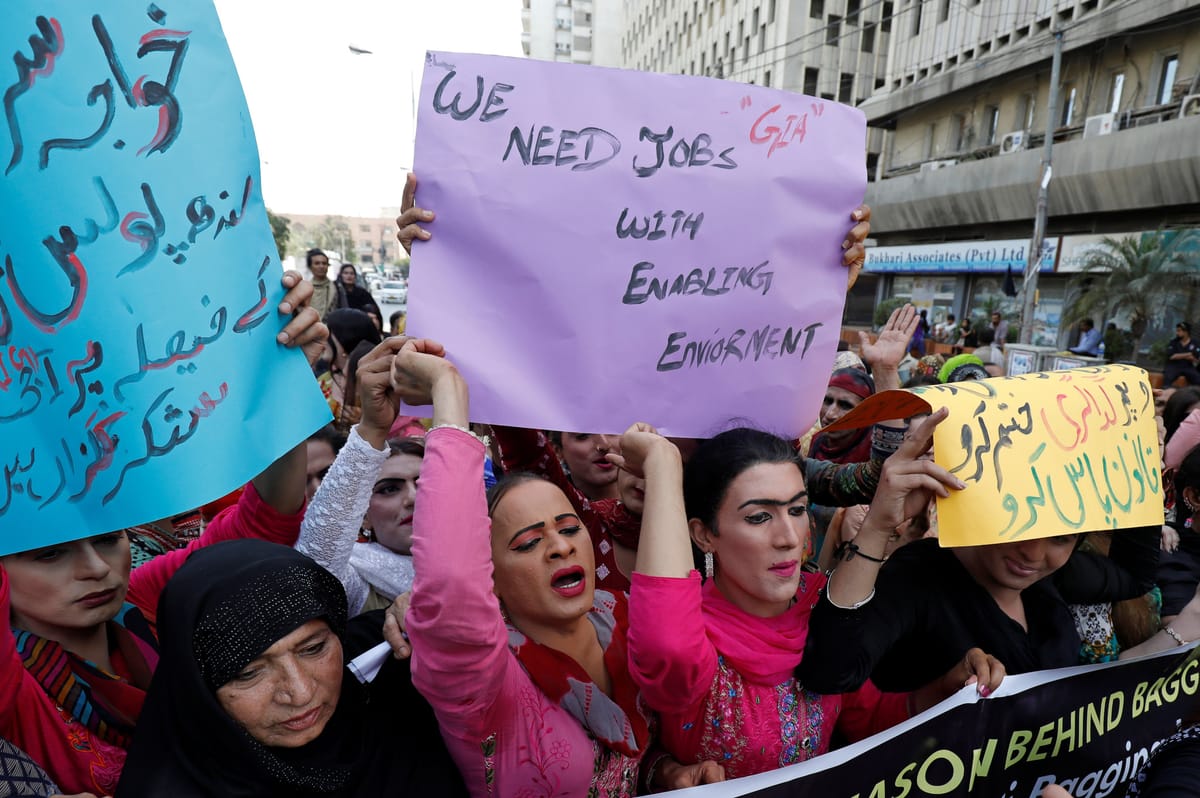
On May 19, 2023, the Federal Shariat Court of Pakistan rendered the Transgender Persons Act 2018 incompatible with Islamic principles. This had a considerable effect on transgender rights and health in Pakistan. Followed by a year-long propaganda campaign led by far-right movements, the verdict exacerbated concerns about transphobic violence. Today, approximately 90% of the transgender community in Pakistan face physical harassment.
Socioeconomic marginalization, especially through discrimination from formal employment, systematically pushed transgender individuals into dangerous industries such as the sex industry. This has evidently increased the rates of drug misuse, sexually transmitted infections(STIs), and mental health issues among transgender individuals. This dehumanization of transgender individuals is further exacerbated by the denial of burial rights, further isolating the already susceptible community.
Compared to other countries using systems similar if not the same to Pakistan’s Islamic Republic, Pakistan is unique in that its transgender community is not fully invisible. In fact, the 2018 law encouraged transgender individuals to live openly, change documents, and seek employment. Now, with the Federal Shariat Court’s ruling of 2023 still active, the transgender community’s hypervisibility inevitably leads to visible, trapped targets, thus explaining the 90% physical harassment figure. Additionally, rape laws exclude transgender women from legal definition.
Most Islamic states handle transgender identity through silence or vague moral codes rather than explicit legislation. Iran permits and even state-funds gender reassignment surgery, framing it as a medical correction rather than a religious violation. Saudi Arabia neither formally recognizes nor explicitly criminalizes transgender identity in the same legislative detail. Turkey has increasingly restricted transgender rights through administrative pressure rather than direct criminalization. Pakistan, by contrast, has gone further than nearly all of them, not by staying silent, but by writing punishment directly into law and targeting the doctors who provide care. What makes this even more striking is that the 2018 Act was once cited internationally as a progressive model, proof that an Islamic republic could protect gender diversity. The 2023 ruling did not just reverse that progress, it transformed visibility into vulnerability.
In a stark contrast to the progressive 2018 law, gender-affirming care is explicitly criminalized, punishing any healthcare provider involved with prison time. In contrast to other Islamic states, in which gender-affirming care is either non-existent, underground, or state-controlled, Pakistan’s laws deliberately go beyond the vague moral codes of nations such as Saudi Arabia and criminalize doctors following WHO standards.
As the LEAP Pakistan analysis notes, "the backlash against the statute highlights the weakness of Pakistan's constitutional system," where the Federal Shariat Court can override secular legislation using biologically deterministic interpretations of Islamic law that reject ijtihad (independent reasoning).
The removal of important provisions from the act of 2018 has resulted in the denial of gender self-identification, legal protection, inheritance rights, health-care accessibility, education, employment, housing, and social welfare for transgender people. The ruling argues, on the basis of medically incorrect and biased statements by conservative petitioners, that gender dysphoria is a curable disease. This is directly incongruent with the WHO’s official statement, which defines gender incongruence as a marked and persistent incongruence between a person’s experienced gender and sex assigned at birth. Furthermore, the stigmatisation and legal difficulties faced by transgender individuals have led to gender identity conversion efforts, which are practices widely discredited by science. “ We are humans as well. The people who make fun of us. they should not. When the police detain us, ask us to take our clothes off. They take off our clothes, they look at what’s outside us. But they can’t see what’s inside us. Why can’t they see it? They look at us and they say, "You are a man”, if we were men would we do this work?”(Justice Project Pakistan). The people who humiliate and strip them down can only see their bodies, but a person is never just their body. Inside lives an identity, a feeling, a truth that no uniform or authority can measure. If society had truly seen them for who they are, they would never have been pushed to the edges in the first place.
The verdict perpetuates sociocultural and economic marginalisation, hindering transgender individuals’ ability to challenge discrimination and access essential services. The verdict is a preamble for a severe legislation misleadingly titled the Intersex or Khunsa (Protection of Rights) Act, proposed by Senator Mushtaq Ahmad. This act, through sections 14 and 20, revoking the legality of all gender-affirming care for transgender and intersex people, criminalises gender variance and transgender identities, and denies protections based on gender dysphoria. The crucial thing to note in this case is that the bill deliberately conflates intersex people (biological variations) with transgender people (gender identity) to ban care for both groups under religious pretexts.
In February 2026, the Khyber Pakhtunkhwa government announced a new transgender policy promising safe houses and police desks. However, similar promises in 2018 were never implemented, and activists report that 170 transgender persons have been killed in that province alone since 2015. Similarly, three severed remains of transgender peoples were found in Karachi in September 2025.
Immediate action is necessary to safeguard transgender rights, to reinstate crucial provisions, and to foster an inclusive society. Revisiting the Transgender Act 2018 in accordance with the World Professional Association for Transgender Health standards is important to strengthen health provisions and to protect health-care providers and seekers from violence and discrimination.
The international community should take notice of the emergency situation in Pakistan, where evidence-based and effective health care for transgender and gender diverse people is being criminalised under the guise of religious and moral panic. The further criminalization of gender-affirming care will further create a hostile and criminal environment for healthcare practitioners.
The most urgently needed action is from the Supreme Court. The Federal Shariat Court’s ruling must be overturned and transgender people’s rights must be securely established before tragedy strikes again. However, the 2023 has not completely overturned the 2018 law. Many groups such as the Justice Pakistan Movement acknowledge that the main problem lies not in the existence of law, but its implementation in an oppressive system.
Key Documentation Links:
Document | Link |
FSC Verdict Analysis (JURIST) | https://www.jurist.org/commentary/2023/06/durani-bansal-pakistan-transgender-shariat-court/ |
Lancet Psychiatry Report | https://www.thelancet.com/journals/lanpsy/article/PIIS2215-0366(23)00191-8/fulltext |
CBS News Report | https://www.cbsnews.com/amp/news/pakistani-transgender-activists-will-appeal-shariah-court-ruling/ |
Amnesty International | |
APCOM Full Case Details | https://www.apcom.org/federal-sharia-court-case-against-transgender-law-pakistan/ |
https://leappakistan.com/recognition-and-resistance-transgender-rights-in-pakistan/
https://dailytimes.com.pk/1469056/transgender-persons-face-torture-risk-in-pakistan-new-policy-brief-warns/#google_vignette