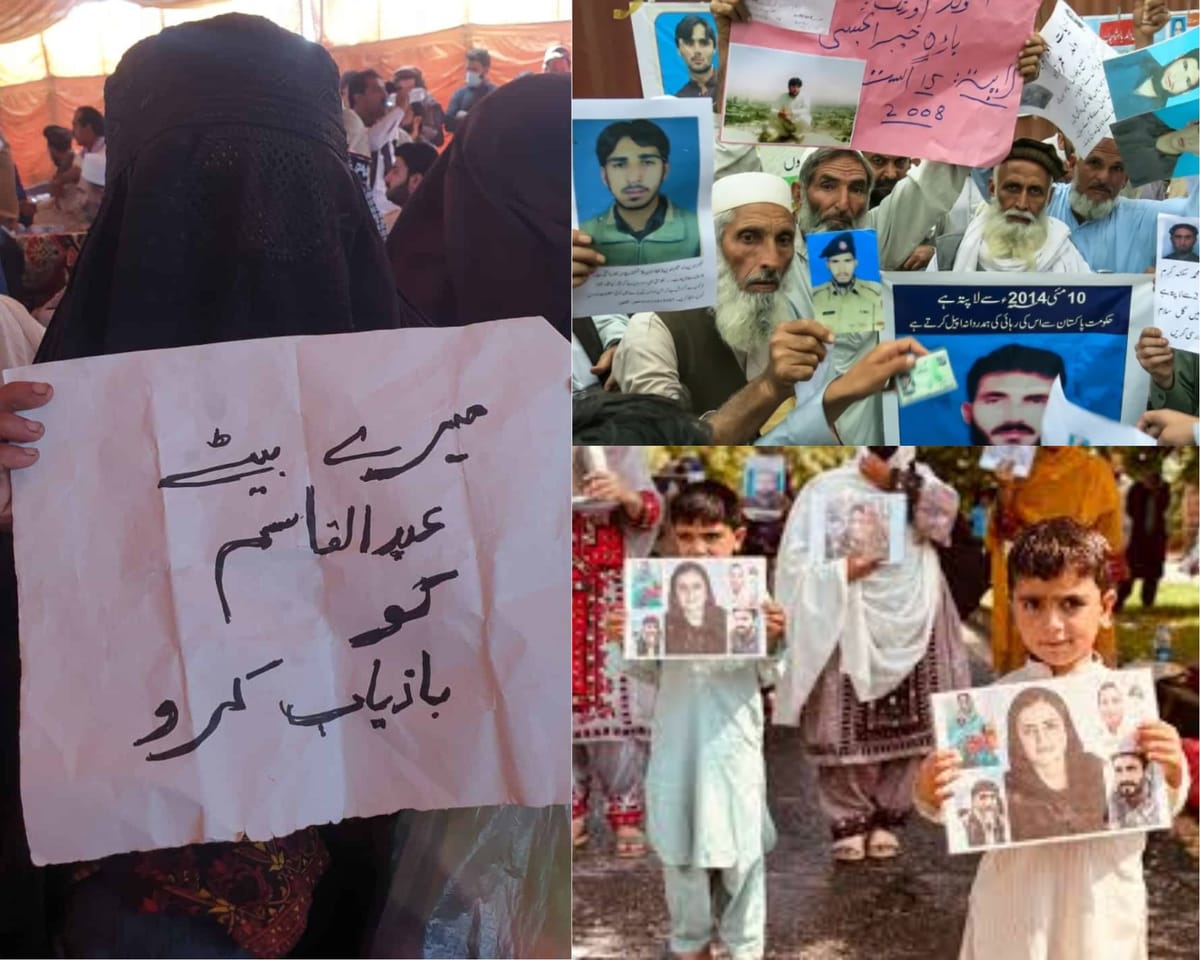
On the left side, a woman in a black Burqa carrying a banner with writing on it (" Release my son Abdul Qasim"), and on the other two sides, old people and children demand the release of their family members (son, father, brother).
Context:
For decades, enforced disappearances have been happening across Pakistan,
As Pakistan's richest province, Balochistan and Khyber Pakhtunkhwa sit on vast reserves of natural gas, copper, and gold, yet remain the poorest, with minimal infrastructure and development projects bypassing local communities.
Although these regions have seen decades of armed separatist conflict, the state's response to dissent makes little distinction between militants and peaceful activists. Groups like the Pashtun Tahafuz Movement (PTM) and Baloch Yakjehti Committee (BYC) organize non-violent rallies and social media campaigns demanding accountability for killings and enforced disappearances. Yet, security forces treat student organizers, poets, and human rights activists as threats to national security.
Several young men were abducted after participating in a peaceful protest organized by the Pashtun Tahafuz Movement (PTM). The demonstration, attended by activists and their families, demanded the release of people who had been forcibly disappeared and unlawfully detained by authorities. Dozens gathered, holding placards and chanting for accountability.
According to one of the survivors, six people were abducted that day. He and his friends had just left the protest site when a black vehicle stopped near them. Several men stepped out and forced them inside. The entire operation only took seconds.
There was no warrant, no explanation, and no identification. He says multiple vehicles and several armed men were involved. Incidents like this, activists say, have become a recurring pattern.
Our source said he was taken into a small room after being blindfolded and transported to an unknown location. “When the blindfold was removed, I found myself inside a cramped cell meant for one person, but four men were kept inside it.”
Out of the six who were abducted, four, including the interviewee, were placed together in the same torture cell. The other two were taken elsewhere at first.
The cell had no windows. There was no natural light, no clock, and no way to tell whether it was day or night. In one corner, a surveillance camera monitored their every movement.
“For seventy days, I couldn't say if it was day or night,” the interviewee explained. “There was a constant sound of a fan outside the cell. That noise was the only sign that the world still existed beyond the walls.”
Inside the cell, the four men spoke quietly among themselves. Some had been taken from the protest, others from different locations. None of them had been shown a warrant or charged with anything.
Resisting Neglect and Abuse: One Breath at a Time
Interrogations began soon after his arrival. He was taken out of the cell repeatedly, questioned, and beaten. The questions were often the same, but the interrogation methods changed.
The survivor says he has a kidney condition and needs regular treatment, yet during the seventy days in detention he received no medicine and saw no doctor. The pain would come and go, and he had no choice but to endure it in silence.
One of the other men suffered from asthma. In the closed, airless cell, he often struggled to breathe. With no inhaler or treatment available the other men tried to comfort him and keep him calm.
There was no medical care. No medicine. Even when injuries worsened, he says, no one treated them. Food was irregular and minimal, and water was limited.
These conditions amount to multiple human rights violations: incommunicado detention, torture, denial of medical treatment, and the absence of any legal process.
The most difficult part, he says, was the uncertainty. He did not know where he was, who was holding him, or whether he would ever be released.
Without sunlight or a clock, time lost its meaning. “The only way I could cope was by focusing on my breathing.” During the interview, the survivor demonstrated how he would inhale and exhale slowly, as if reliving those moments.
“That is how I survived seventy days,” he emphasized, “One breath at a time.”
Two Men Still Missing
After seventy days, he was blindfolded again, taken out of the cell, and driven for some time before being left on a roadside. There was still no explanation, no paperwork, and no charges.
Four of the six abducted men, including the interviewee were eventually released. But their release came with a warning. They were told that if they ever spoke about what had happened to them, they would be killed in front of their families, they were told, “just as it had been done to many others.” The threat was clear, and the message was meant to silence them.
However, two others are believed to remain in detention. According to the survivor, one of those remaining detainees has now disappeared for the third time. He had previously been taken and released twice before.
Now free, the survivor says he is speaking out not only about his own ordeal, but also for the two men who remain in detention.
According to our sources, when he finally returned home, the whole community gathered. Neighbours, relatives, and friends welcomed him back, many of them shocked by his weak physical condition but relieved that he was alive. For months, people in the area had been talking about his disappearance, and his return felt like a moment of collective relief. Some elders said it reminded them of many other young men who had gone missing and never came back.
For his family, the moment was deeply emotional. The family said those days of disappearance were the hardest of their lives, filled with fear, uncertainty, and sleepless nights. His return did not erase the pain, but it gave them a moment of relief and hope.