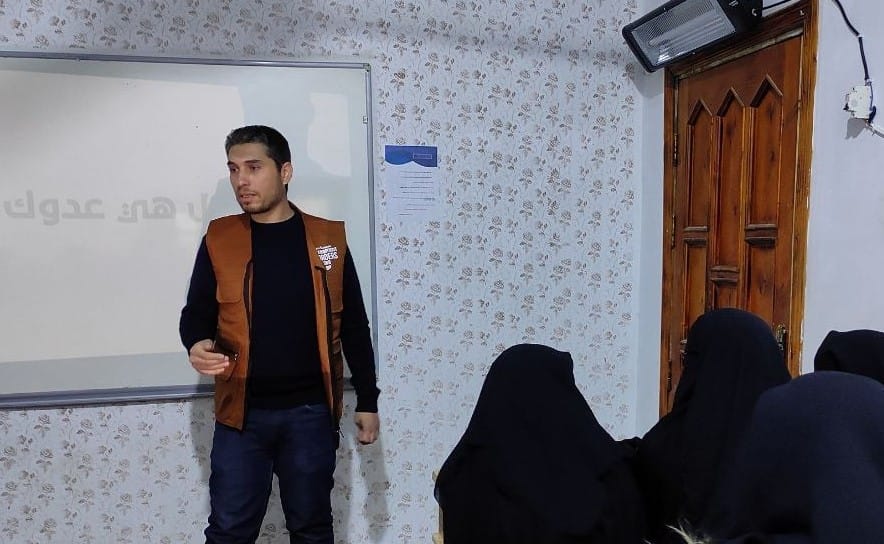
Mohammed Kamal joined Raise the Voices in 2022 after responding to a call for Arabic translation support. At the time he was living in North West Aleppo, and his first job was learning about what happened to the Iraqi journalist Tawfiq Altamimi, a disappearance case still unsolved.
It would be easy to say he was a volunteer like all the others, but that wouldn't be accurate, because he was the person living it, not just reporting. He wasn’t peering in from the outside to then tell the world what was happening in Syria. His life was completely upended by war, an experience he channeled into building bridges through translation, humanitarian action, and advocacy, all while experiencing displacement himself. His experience shaped his work and the work of the ones around him.
‘I wanted to do something concrete instead of just watching from the sidelines.’
When the war started in 2011, Mohammed was still young, and for years he was left feeling hopeless in a war torn country. His family became part of the millions displaced within Syria's borders, moving from place to place as internally displaced persons (IDPs). After years of displacement, he made a choice: he wanted to become involved in what was happening around him, describing the moment as a turning point in his life: ‘I wanted to do something concrete instead of just watching from the sidelines.’
Mohammed began as a volunteer field translator. His translating was not only linguistics, but he provided accounts of what being an IDP meant, what bureaucracy and the humanitarian system signified, all transcending language and retelling the system from the inside out.
As primary inspiration for the path he chose, he credits the Syrian women working as journalists and human-rights defenders, despite the enormous risks they faced. They were community members documenting their own reality, much as Mohammed was using his own experience to frame his work. He emphasized that being a Syrian woman doing journalist work has its added difficulties, such as traveling alone especially during war when they become targets for gender-based violence. He found their bravery inspiring and hoped that joining their efforts would send out in the world an accurate picture of the war in Syria.
Raise the Voices and Advocacy Work
For him, becoming part of Raise the Voices felt ‘like a way to turn pain into something constructive’. The organization focused, among other things, on amplifying Syrian civil-society voices and documenting human-rights violations in a ‘dignified and professional way’. Mohammed was drawn to how the NGO centered those with lived experience, giving them a platform rather than speaking for them. He sees this as ‘professionalism with genuine respect and amplifying the voices of those most affected, making the work feel more sustainable and impactful on a human level.’ Mohammed was himself among those the organization sought to support, someone reporting from inside the crisis, not observing from outside.
One of the things he deeply appreciates about the direction of the NGO is the unconditional support he’s received, something he particularly values in the relationship with the founder, Golda Velez, whose work stands on the principle of serving the other. Things don’t happen transactionally, reminding Mohammed that ‘the world still has good people to live with’. He says the focus is always on how to help, what can be done for people, no matter how small. He invokes the driving principle of the NGO which is that even a small thing is effective, and that over time it has ripple effects in communities.
His commitment to bridge the gap between what the world knew that was happening in Syria and the day to day realities of a war torn country led to him becoming the Director of Raise the Voices, and taking on more responsibility, organizing and moderating meetings, supporting the team of volunteers in continuing to speak with the people directly affected by human rights violations, bringing their voices and stories out of anonymity.
Between Two Identities
As for the field based humanitarian work, Mohammed doesn't talk first about the direct impact of alleviating materials needs, but rather what the support means: the hope humanitarian workers represent, and how it shows communities they are not forgotten. He talks about how important it is to make people smile, spread positivity especially in the midst of a crisis. Helping people harbor hope gives them a reason to look into the future and not lose their purpose: ‘When we help some people, they start smiling and we spread positive energy so they can continue their life even when they feel despair.’
For Mohammed there are two identities, that of the IDP and that of the humanitarian worker. He navigates both realities, living in the same camp as those he serves, sharing their lived experience. His neighbors, acquaintances, and friends are also the people receiving help, yet he always remains professional, treating everyone equally. His efforts to maintain boundaries between these roles are repaid, as the community appreciates his work and he says he’s proud that people smile when meeting him in the camp.
Leveraging Lived Experience Professionally
Mohammed's experience spans multiple roles that capitalize on his background and skills. As Director of a computer and English language training center and Team Leader of Syrians Without Borders, he has operated across educational, community development, and advocacy sectors simultaneously.
His certification as a Training of Trainers (TOT) Coach enables him to build local capacity which is critical in building the resilience of on the ground staff and volunteers. As a professional English-Arabic translator, teacher, writer, and journalist, he specializes in cross-cultural communication, content creation, Arabic research, and bilingual training delivery. These interconnected tools bridge the gap between Syrian communities and international systems.
What distinguishes his work is the perspective he brings. For years, managing teams and operations in conflict-affected areas was his daily reality and his decisions were informed by his own experience of what displacement means to a family or to a community. Using storytelling and journalism to amplify community issues isn't advocacy from a distance, but a way to also talk about the issues affecting his own life as well.
Rebuilding Syria and Funding Challenges
When discussing challenges, Mohammed identifies three main struggles in humanitarian action, drawn from direct operational experience. He unequivocally names the politicization of aid, short funding cycles as a real hindrance to long-term planning and the gap between the humanitarian principles and on the ground realities.
However, he is hopeful looking towards the future, and sees his country as ‘more stable than many outsiders realize. People are rebuilding their houses and cities. But critical needs remain: jobs, medical services, and reconstruction support.’
He considers medical facilities the primary need for Syrian society as well as the need for new jobs and economical opportunities as people struggle to earn a living and rebuild their lives.
On a personal level, Mohammed hopes to return to his home city, though his house was destroyed during the war. ‘Rebuilding it would cost approximately $5,000.’ He says, but the sum is not something he can easily obtain. Despite this, he and his family remain hopeful about the possibility of return.
If you would like to get in touch with Mohammed, you can reach him at Mohammedkamalmugir@gmail.com