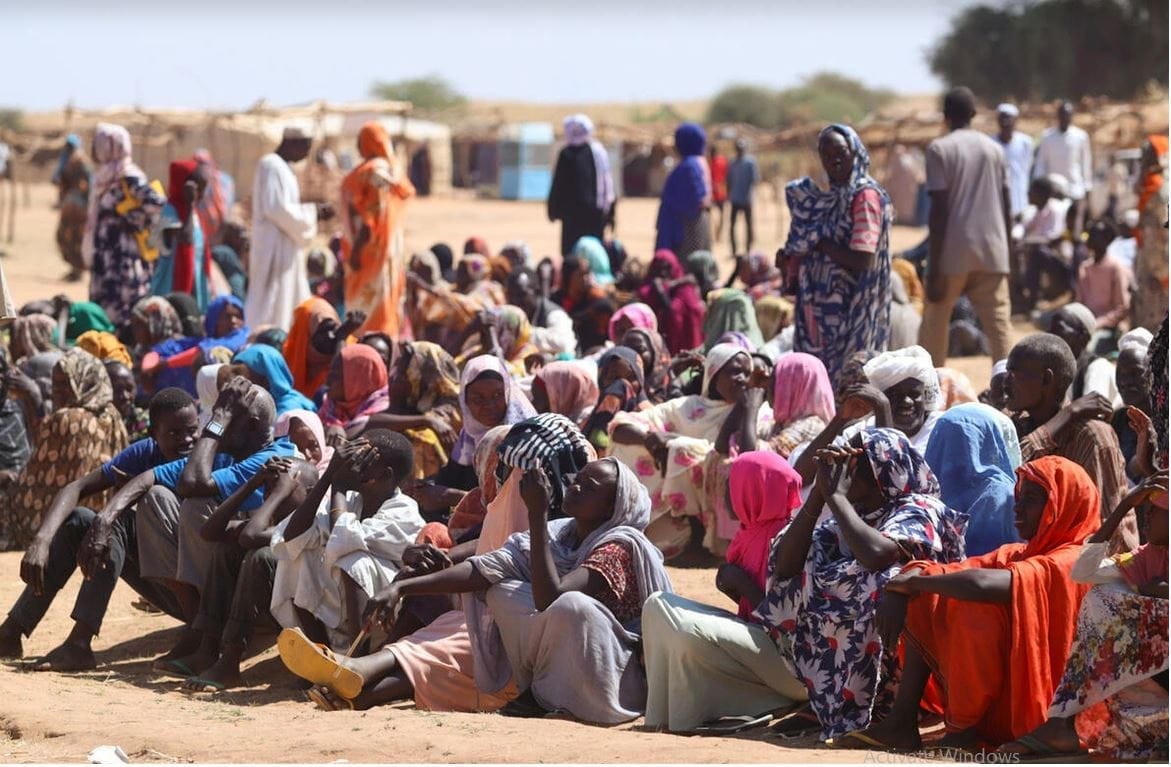
Sudan is facing one of the world's worst humanitarian crises, yet it remains largely invisible to the international community. Since April 2023, a brutal civil war has been raging between two military forces: the Sudanese Armed Forces (SAF) and the Rapid Support Forces (RSF). The numbers are staggering: more than 150,000 people dead, 12 million forced to flee their homes within Sudan, and 26 million people facing severe hunger.
In October 2025, the RSF captured El-Fasher, the last city in Darfur that was still controlled by the army. What followed was a massacre. Researchers at Yale University's Humanitarian Research Lab used satellite images to document mass killings happening on the ground.
Meanwhile, U.S. intelligence agencies confirmed that the United Arab Emirates (UAE) has been increasing its weapons shipments to the RSF, even as the militia stands accused of
genocide.
This tragedy didn't come out of nowhere. In 2019, the Sudanese people achieved something remarkable: they overthrew a genocidal dictator through peaceful mass protests. They had a chance at democracy. But in 2021, military generals staged a coup. The international community failed to protect Sudan's democratic transition and failed to hold the UAE accountable for fueling violence. Now, genocide has returned to Darfur.
The article was written with the support of Dr. Jihad Mashamoun, a Sudanese political analyst and researcher specializing in the Horn of Africa, who generously shared his knowledge and insights throughout the reporting process.
Understanding the Players: SAF and RSF
The war in Sudan isn't a fight between the government and some outside rebel group. It's something more tragic: the former regime is hiding behind both sides , supporting the SAF while also using the RSF as a vehicle to reclaim power , turning the country into a battleground for its own political survival while ordinary people pay the price. The SAF for decades has been at the center of political power in Khartoum (Sudan's capital). Under dictator Omar al-Bashir, who ruled from 1989 to 2019, the army fought brutal campaigns against regions like Darfur.
But to keep their hands somewhat clean politically, they increasingly outsourced the worst violence to allied militias. Between 2003 and 2008, these militias, known as the Janjaweed, were used to crush non- Arab communities in Darfur, particularly the Fur, Masalit, and Zaghawa ethnic groups. The pattern of attacks was horrifyingly consistent: Sudanese military planes would bomb villages first, then the Janjaweed militias would sweep in on the ground, killing civilians, raping women, burning homes to the ground, and even poisoning water sources. Hundreds of thousands of people were killed, and millions were forced to flee. The world recognized these crimes as genocide.
But here's where things get even worse: instead of disbanding these militias after the genocide, the regime made them official. In 2013-2014, al-Bashir transformed the Janjaweed into the Rapid Support Forces (RSF), a paramilitary organization separate from the regular army but directly answering to the president. The RSF was led by Mohamed Hamdan Dagalo,known as Hemedti, and they kept using the same brutal tactics. Human Rights Watch documented war crimes by the RSF almost immediately after it was created.
Dr. Jihad Mashamoun, interviewed for this article explained, "Figures from the former regime were deliberately integrated into both the Sudanese Armed Forces and the Rapid Support Forces, embedding old power networks within state institutions, which has made genuine reform nearly impossible." In other words, the same people who committed genocide were now part of the official state structure. This made real change almost impossible.
After al-Bashir was overthrown in 2019, many hoped for justice and accountability. Those hopes quickly faded. The SAF and RSF joined forces to protect their own interests during the transition period. On June 3, 2019, RSF forces attacked peaceful protesters who were staging a sit-in in Khartoum. They killed more than 100 demonstrators and threw bodies into the Nile River. Despite this horrific crime, the RSF was still brought into the transitional government
without facing any consequences.
The alliance between the SAF and RSF was never going to last. They began fighting over who would control the state, who would control Sudan's resources, and whether the RSF would be absorbed into the regular army. In April 2023, these tensions exploded into full-scale war.
How We Got Here: From Revolution to Collapse
The 2019 Revolution: A Brief Moment of Hope
In December 2018, Sudanese people took to the streets to protest rising food prices. What started as demonstrations about bread quickly became something much bigger. On January 1, 2019, hundreds of civic organizations came together to form the Forces of Freedom and Change (FFC), coordinating peaceful resistance against Omar al-Bashir's regime.
It's important to understand that while the revolution brought many people together, the civilian movement wasn't united. As Dr. Mashamoun pointed out, "Civilian movements were not monolithic; internal splits within political parties and infiltration by political actors weakened grassroots independence and undermined a unified civilian front." These divisions would later
make it harder for civilians to resist military control.
Omar al-Bashir had ruled Sudan with an iron fist for thirty years. The International Criminal Court had issued a warrant for his arrest for genocide, crimes against humanity, and war crimes committed during the Darfur conflict (2003-2008), when an estimated 200,000 to 400,000 civilians were killed.
On April 11, 2019, al-Bashir was forced out of power. A transitional government was set up, combining civilian and military leadership, with economist Abdalla Hamdok at the helm. The goal was to prepare the country for democratic elections. For a brief moment, it seemed like Sudan might finally have a chance at peace and democracy.
The 2021 Coup and the Regional Counterrevolution: Democracy Crushed
On October 25, 2021, General Abdel Fattah al-Burhan, head of the SAF, and General Mohamed Hamdan Dagalo (Hemedti), head of the RSF, jointly planned and carried out a military coup. Together, they dissolved the transitional government, arrested civilian leaders, and effectively ended Sudan's path to democracy. While some civilians and the RSF have since claimed that Burhan acted alone and that Hemedti was deceived, Dr. Mashamoun
doesn't buy that narrative, Hemedti and his RSF were actively planning, coordinating, and executing the coup alongside Burhan and his allies.
The coup didn't happen in isolation. It was facilitated by what we might call a regional counterrevolution, led by the United Arab Emirates, Saudi Arabia, and Egypt. These authoritarian governments see democracy as a threat to their own systems of power . Notably, Burhan travelled secretly to Egypt before the joint coup, and according to Dr. Mashamoun, both Burhan and Hemedti were counting on the UAE and Saudi Arabia to support them in its aftermath. The European Union also bears responsibility: they prioritized migration control agreements with Sudan's military leaders over supporting democracy, essentially reinforcing
the same forces that would later stage the coup.
According to Dr. Mashamoun, the civil war wasn't a sudden break but rather "the culmination of unresolved power asymmetries following the failed transition." In other words, the military leaders had external support and money that protected them from civilian pressure, while civilian groups lacked the unity and power needed to counter the military's strength. The coup created conditions that made large-scale war not just possible, but likely.
The Civil War (2023 to Present)
The alliance between the SAF and RSF had always been fragile and opportunistic. While the two forces cooperated to suppress civilian opposition, most notably during the June 2019 massacre, they remained rivals competing for state power and economic resources.
The breaking point came over integration. The transitional framework required merging the RSF into the regular army, which would have placed Hemedti's forces under al-Burhan's command and ended the RSF's lucrative control over gold mines in Darfur. With substantial financial and military backing from the UAE, Hemedti had the resources to reject
subordination.
On April 15, 2023, what began as a tactical alliance against democratic transition collapsed into open warfare. Backed by Emirati funding and weapons, the RSF launched attacks across the country, plunging Sudan into full-scale civil war.
As the interviewee explained, "The conflict was shaped as much by foreign influence as by internal divisions, with funding and political backing from the UAE and other Gulf actors empowering the RSF to act independently and decisively." This foreign support not only made the war worse but also betrayed the 2019 revolution by strengthening military power at the expense of civilian voices.
The human cost has been devastating:
● More than 150,000 people killed;
● 12 million people displaced within Sudan (forced to flee their homes but still inside the country);
● 3 million refugees who fled to neighboring countries;
● At least 26 million people are facing acute hunger (meaning they don't know where their next meal will come from).
The El-Fasher Massacres (October–November 2025)
El-Fasher is the capital of North Darfur, home to approximately 1.8 million people. It was the last city in Darfur still controlled by the SAF. After a siege lasting more than 500 days (that's nearly a year and a half), the RSF captured the city on October 26, 2025.
What happened next was horrifying. Researchers at Yale's Humanitarian Research Lab analyzed commercial satellite images and found clear evidence of mass killings. They identified more than nineteen locations in the Daraja Oula neighborhood where evidence suggested door-to-door executions had taken place. Satellite images showed clusters of objects measuring between 1.3 and 2.0 meters (about the size of human bodies), along with reddish soil discoloration (consistent with blood).
At the Saudi Hospital alone, at least 460 people were killed, including patients and medical staff. Freshly disturbed earth around the hospital indicated mass graves. Shockingly, RSF fighters posted videos of themselves carrying out executions inside hospitals.
Nathaniel Raymond, the executive director of the Lab, reported that their contacts on the ground initially reported 1,200 deaths, then the number jumped to 10,000, and then all communication stopped. The lab's analysis concluded that the evidence clearly showed ongoing mass killings.
More than 70,000 people fled El-Fasher after its capture. Reports continue to emerge of widespread sexual violence against women and girls.
The UAE's Role: Fueling Genocide for Profit
In October 2025, The Wall Street Journal published a major investigation based on U.S. intelligence reports. It confirmed what many had suspected: the UAE has been significantly increasing its weapons shipments to the RSF.
Both the Defense Intelligence Agency and the State Department's Bureau of Intelligence and Research documented growing weapons flows starting in early 2025. The weapons are routed through Libya and Somalia before being transported by land into Sudan. The U.S. has battlefield imagery and signals intelligence (intercepted communications) that confirm these supply routes.
Cameron Hudson, who formerly served as chief of staff to U.S. presidential envoys for Sudan, made a stark statement: the war would likely have ended without Emirati support. The RSF's ability to keep fighting depends heavily on weapons and funding from the UAE.
Why Is the UAE Doing This?
The answer is natural: resources and money. Hemedti operates companies registered in Dubai that convert "conflict gold" (gold mined in war zones, often using forced labor) into hard currency. An investigation by The Sentry revealed that illegally mined Sudanese gold is being sold through DubaThe UAE also wants access to Sudan's agricultural land and seeks broader influence across the region.
Beyond gold and land, as Dr. Mashamoun points out, the UAE seeks control over Sudan's ports in the Red Sea, a waterway through which 12–15 percent of global trade passes, a strategic foothold that would allow the UAE to position itself as an equal partner to the US in both the Middle East and Africa.
Here's a crucial timeline: in early 2025, the RSF suffered major defeats, including the loss of Khartoum (Sudan's capital). The war might have ended then. But renewed support from the UAE revitalized the RSF, enabling the most destructive phase of the war, including the El-Fasher massacres.
The World's Inadequate Response
In April 2025, Sudan formally accused the UAE of complicity in genocide before the International Court of Justice (the world's highest court for disputes between nations). Despite this serious accusation, the UAE continues to maintain close, friendly relations with Western powers.
Here's a revealing example of how international politics works: In April 2024, the United Kingdom declined to defend the UAE during a United Nations Security Council meeting about Sudan. In retaliation, the Emirati government canceled meetings with British ministers. British officials then advised African diplomats to avoid publicly criticizing the UAE's role in the conflict.
As Dr. Mashamoun said in the interview, "Broad sanctions rarely reach those making decisions on the ground; targeted measures against specific individuals and military units and labelling the RSF as a terrorist organisation are far more effective in limiting violence without harming civilians." Such measures would send a clear signal that those backing the RSF will face economic repercussions, pressuring not only the RSF's external supporters, but also former regime figures hiding behind the state and their own paramilitary groups, many of whom
are living in countries considered US allies, such as Turkey, Qatar, and to some extent Egypt.
Without cutting off the external funding and weapons flowing to the RSF, international responses remain largely symbolic gestures that don't stop the killing.
Glossary
Sudan: A country in northeastern Africa.
Khartoum: The capital city of Sudan and the traditional center of political power in the country.
Darfur: A region in western Sudan that has been the site of ongoing conflict and
humanitarian crises since 2003. Home to various ethnic groups including the Fur, Masalit, and Zaghawa peoples.
Omar al-Bashir: Former president of Sudan who ruled from 1989 to 2019. He is wanted by the International Criminal Court for genocide, crimes against humanity, and war crimes committed during the Darfur conflict (2003-2008).
Janjaweed: Arab militias armed and supported by the Sudanese government between 2003 and 2008 to suppress non-Arab communities in Darfur. The militias were later institutionalized as the Rapid Support Forces.Sudanese Armed Forces (SAF): Sudan's regular military, which has historically occupied the center of political power in Khartoum.
Rapid Support Forces (RSF): A paramilitary organization created in 2013-2014 by formalizing the Janjaweed militias.
Hemedti (Mohamed Hamdan Dagalo): Leader of the Rapid Support Forces and former deputy head of Sudan's Transitional Sovereignty Council. Known by his nickname "Hemedti," he commands the RSF paramilitary and controls lucrative gold mining operations
in Darfur.
Forces of Freedom and Change (FFC): A coalition of civic organizations formed on January 1, 2019, that coordinated nonviolent resistance against Omar al-Bashir's regime during the Sudanese Revolution.
El-Fasher: The capital city of North Darfur state, with a population of approximately 1.8 million. It was the last major city in Darfur under SAF control until its capture by the RSF in October 2025